Nordic Chase (CPH-OSL)
Participated in a 700km+ race from Copenhagen, Denmark to Oslo, Norway. Thanks to pristine roads, stunning scenery, and flat terrain, I completed my first multi-day overnight ride without major difficulties.
Nordic Chase?
Nordic Chase is a competitive ultra-cycling event starting in Copenhagen, Denmark, passing through Sweden, and finishing in Oslo, Norway. The total distance is 730 km with 5,200 m of elevation gain.
Gregory Sanders, along with his friends and family, host and support the event. Around 100 participants took part. There is no external support like resupply; it’s a self-supported journey to the finish line.
I stumbled upon this event online back in September 2025 while still in Korea and signed up. The base entry fee was 1,950 DKK (~450,000 KRW or £220), with an extra charge for a souvenir cycling cap/t-shirt.
Pre-Ride Logistics: Bournemouth, UK → Copenhagen, Denmark
The straight-line distance from Bournemouth to Copenhagen is about 1,100 km. Ordinarily, I would have looked for flights, but with my family and three bikes (my road bike plus two Bromptons), driving was the only realistic option. 😭 To cross the English Channel to continental Europe, we usually took the ferry from Portsmouth to Brittany, France. However, driving all the way from Brittany to Copenhagen was too daunting. Instead, we drove to Harwich and took the overnight ferry to the Netherlands. Leaving home at 15:00, we set foot on Dutch soil by 08:00 the next morning.
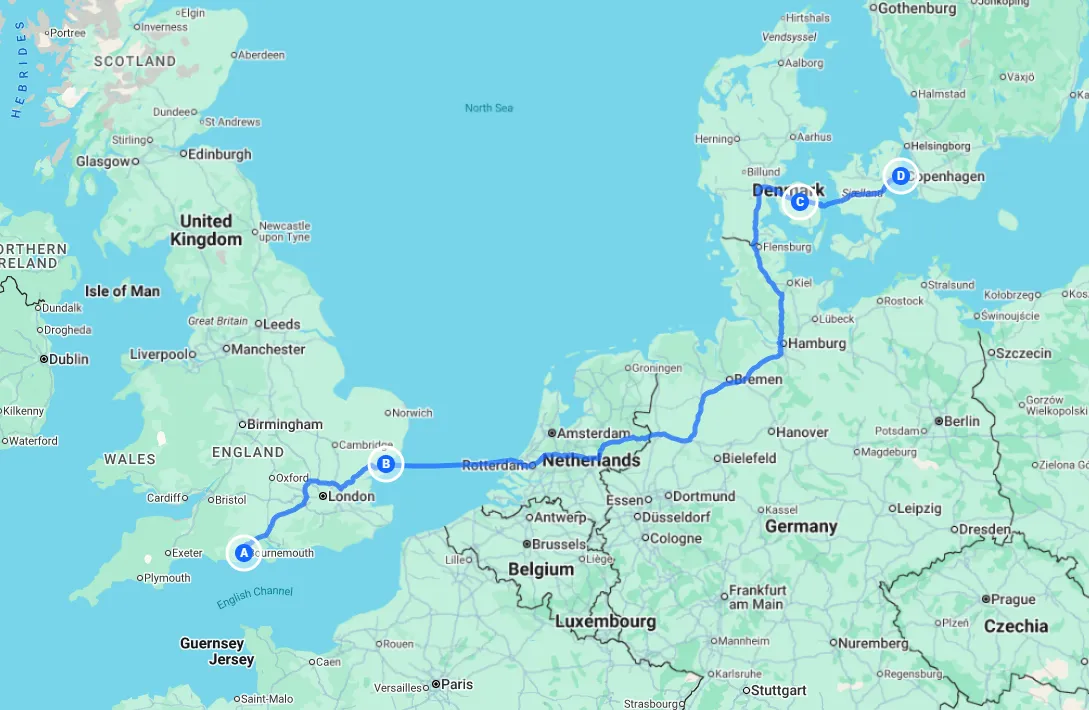 I learned that direct ferries from the UK to Denmark were discontinued before COVID-19.
Fascinatingly, while Nordic Chase was set to be my longest ride ever, our car was also setting mileage records day by day. After landing in the Netherlands at 08:00, we drove another 1,000 km to arrive in Copenhagen that evening. Taking a ferry from Puttgarden, Germany to Rødby, Denmark would have shortened the route, but to avoid the hassle of check-in procedures, we simply drove around through Odense. That 1,000 km drive was our family’s longest road trip to date, and arriving at a rather disappointing accommodation was quite a plot twist.
The day before the start, there was a briefing event to explain the route and hand out cycling caps with race numbers and GPS trackers. We arrived a bit late after strolling around Copenhagen with our dog, and our dog kept barking during the presentation, drawing everyone’s attention. My bib number was neat #100, which felt like a good omen to start. The field of riders looked notably younger than typical gran fondos.
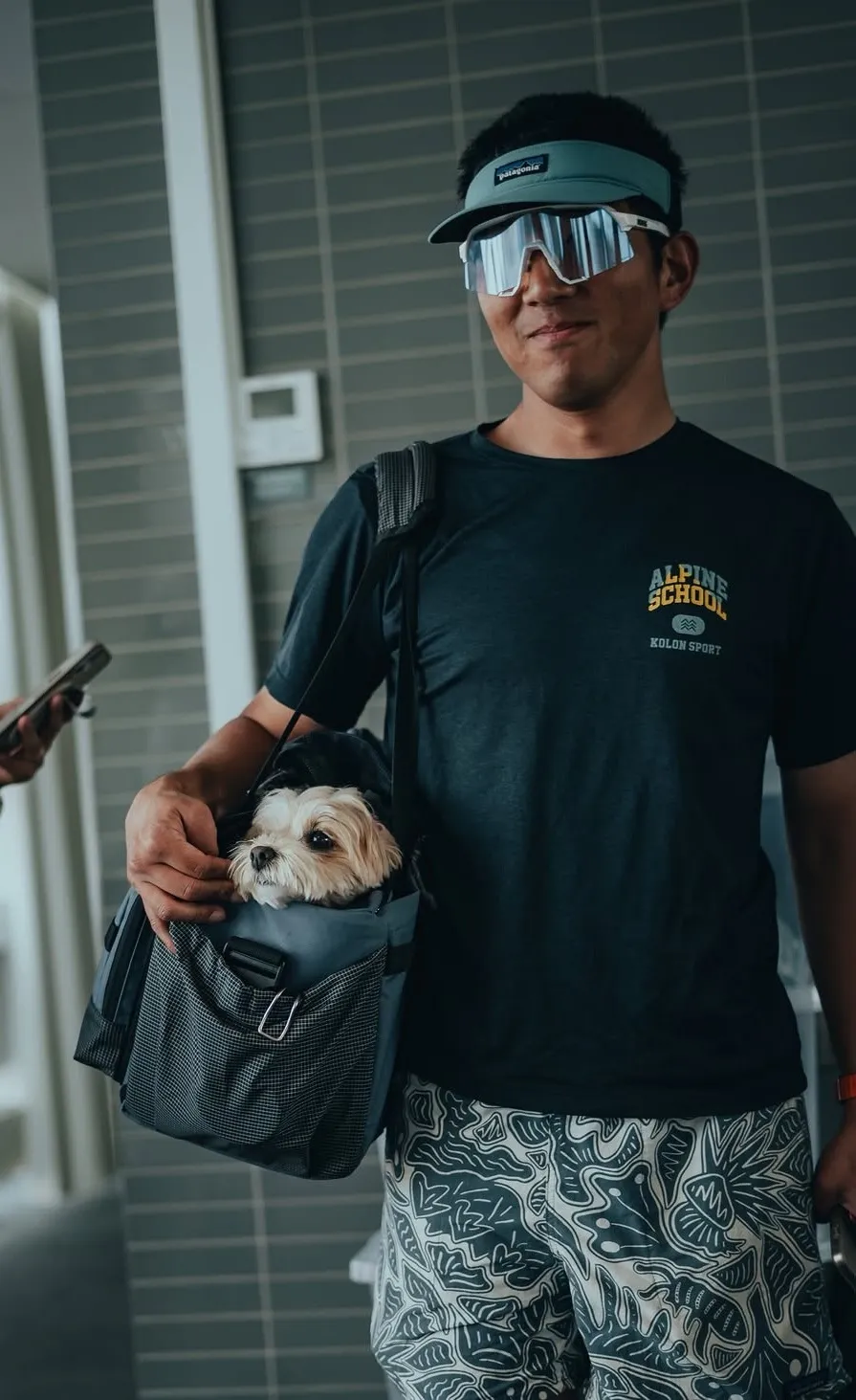 Source: https://www.instagram.com/nordic.chase/
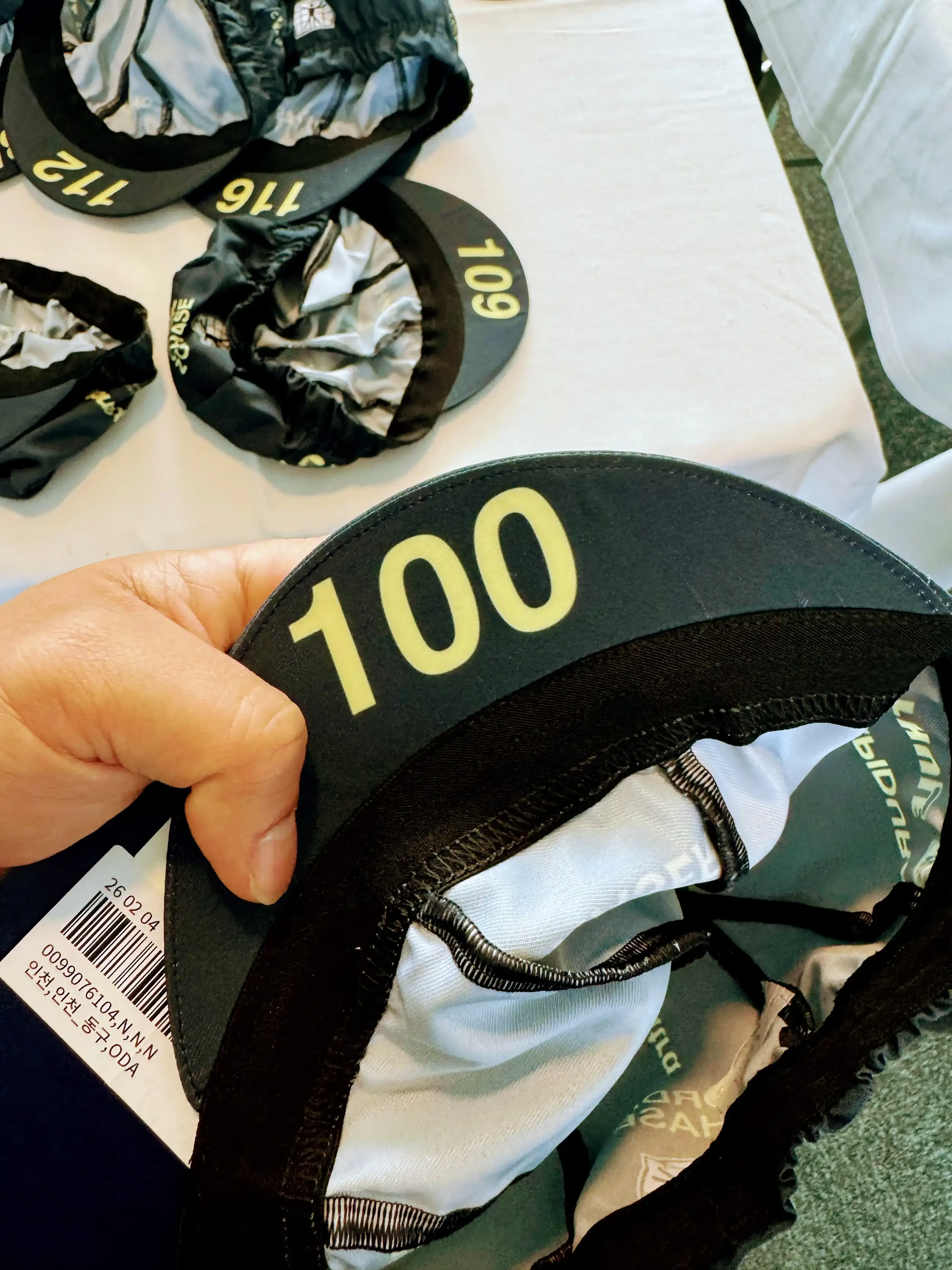 My bib number was #100.
Although there were several announcements, the pre-distributed official manual was so well-made that I could just listen passively.
Riding Strategy: A 2-Day Plan (1 Night Stay)
Having finished a 300K BRM a month prior and the Dragon Ride (300 km / 4,500 m) just a week earlier, my confidence was sky-high. Even though those were single-day rides, they gave me a good sense of what happens to my body after 300 km in the saddle.
I knew I could ride beyond 300 km a day, but not knowing how much beyond made me anxious. The question was whether to complete the 730 km course with 1 overnight stop or 2. After much deliberation, I chose a 1-night plan, driven by the nearly non-stop daylight, my family waiting in Oslo, and the belief that “a challenge should be challenging!” My cycling mentor back in Korea advised me not to cut sleep too drastically, so knowing I would get at least 6 hours of sleep gave me peace of mind.
Day 1 was planned as 340 km from Copenhagen to Gothenburg, Sweden. Staying in a larger city felt safer in many respects. Day 2 would cover 390 km from Gothenburg to Oslo, Norway. Riding further with more elevation gain on the second day meant relying on pure grit—a strategy that wasn’t particularly smart, in hindsight. 😅
Gear Setup: As Little As Possible
My gear setup was minimalist. Along with my basic short-sleeve jersey and bib shorts, I only brought a wind jacket since the nights weren’t expected to be too cold. I packed two spare tubes, two CO2 cartridges, and tire levers—all stuffed into a tool keg in one bottle cage. Because the sun sets as late as 23:00 and twilight remains bright throughout the night, headlights were only necessary for about 3 hours. Since I planned to sleep during those hours, headlight use was minimal, though I brought one just in case.
I crammed about 10 energy gels into my jersey pockets. The wind jacket, passport, and charging gear (cables, power bank) went into the saddle bag. I wondered if I even needed a saddle bag for so little, but it was the only bag I had.
I considered packing extra underwear, slippers, and a spare set of kit for the hotel stay, but decided I could forgo them with a bit of minor discomfort. I washed my jersey and bib shorts before sleeping and slept unclothed in the hotel bed. 🙈 I also debated bringing an action camera, but decided against adding extra variables to my first multi-day ride.
While I was agonizing over these minor details, others had completely different setups. On race day, almost everyone had top tube bags, handlebar bags, TT aero bars, and even backpacks on top of their saddle bags. 😮 Some even carried bivvy bags to sleep outdoors without hotel bookings. I even saw someone with four water bottles! I carried just one, planning to stop frequently to refill. Having barely filled half of my small saddle bag, I felt anxious that I had prepared completely wrong.
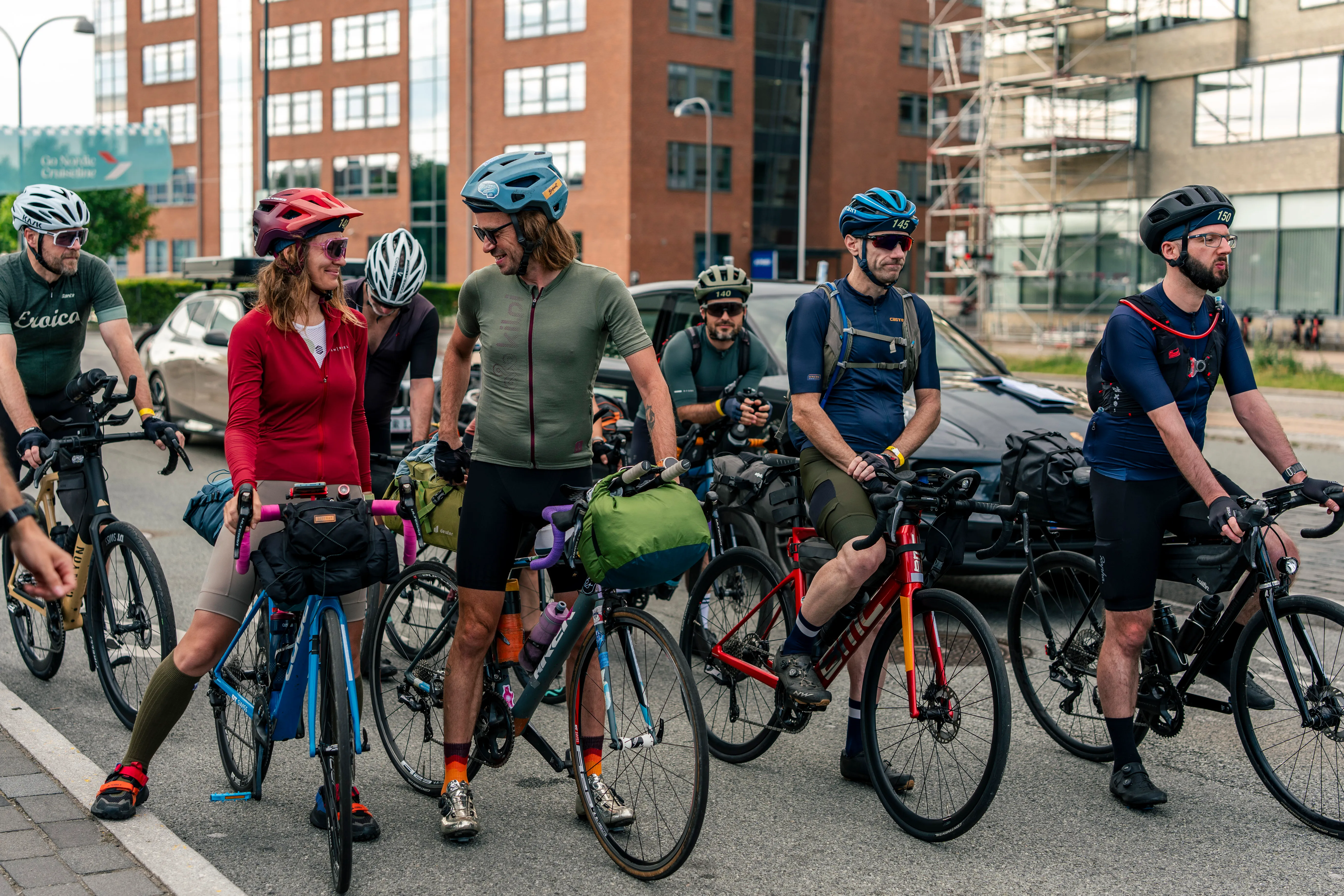 Everyone was packed to the brim. Source: https://ezeekwheel.pixieset.com/2026nordicchasebercphcopy/
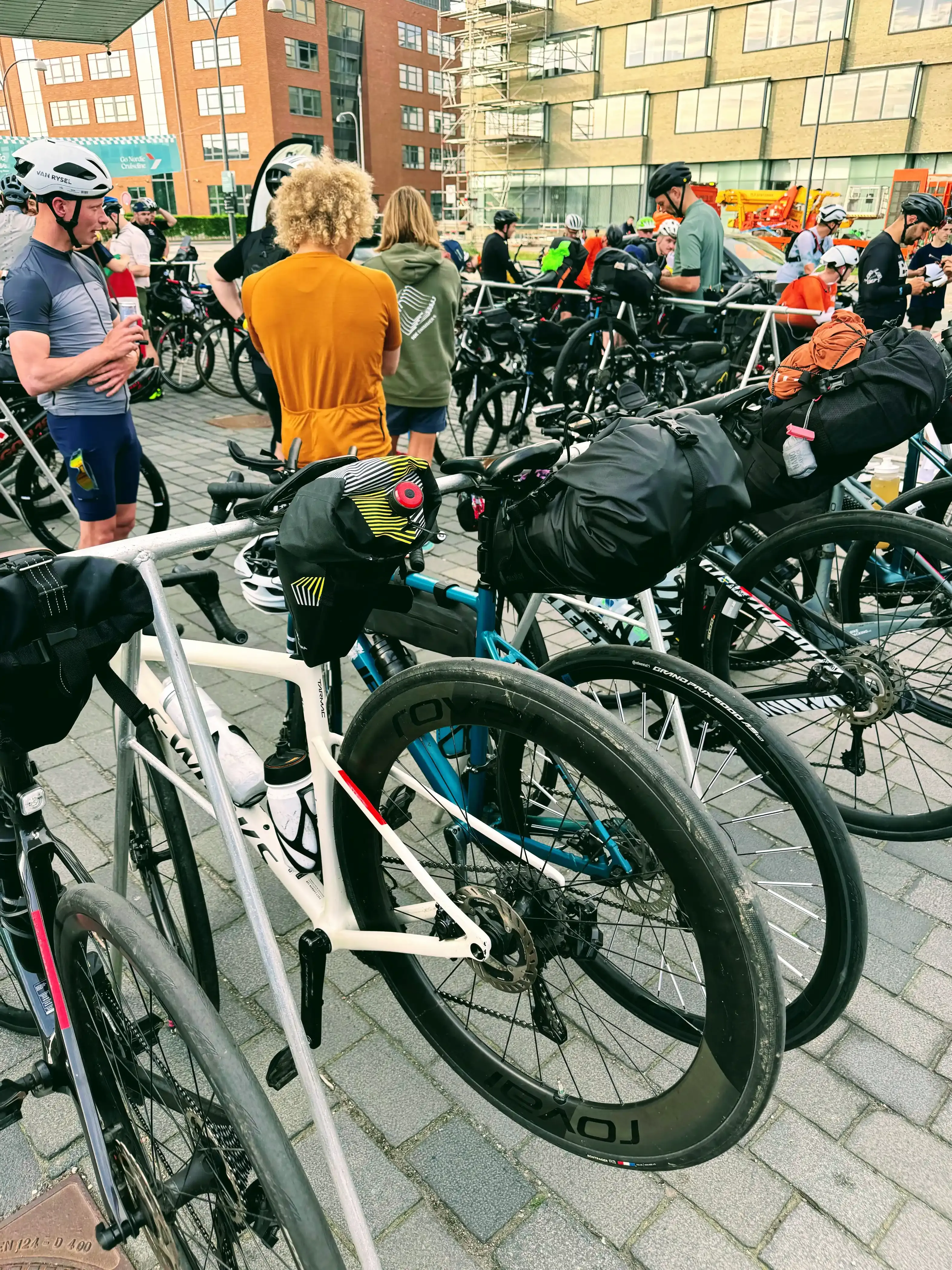 Yes, that small saddle bag is all I have.
Out on the Road…
| Location | Distance (km) | Elevation Gain (m) | Arrival Time | Avg Speed (km/h) | Break |
|---|---|---|---|---|---|
| 1st day | 343.1 | 1801 | for 14:36 | 23.5 | - |
| Start: 🇩🇰 Copenhagen | 0 | 0 | 07:07 | - | - |
| Elsinore | 62.2 | 406 | 09:11 | 30.1 | - |
| ⛴️ Ferry | - | - | - | - | 41mins |
| 🇸🇪 Helsingborg | 62.2 | - | 09:52 | - | - |
| Mellbystrand | 140.7 | 382 | 12:33 | 29.4 | 11mins |
| Falkenberg | 213.9 | 354 | 15:23 | 27.5 | 15mins |
| Tvååker | 241.3 | 82 | 16:41 | 26.2 | 12mins |
| Varberg | 246.7 | 20 | 17:06 | 25.3 | 15mins |
| Frillesås | 279.5 | 174 | 18:44 | 23.5 | 9mins |
| Gothenburg | 343.1 | 383 | 21:43 | 22.4 | 😪 6h58m |
| 2nd day | 387.4 | 3917 | for 20:19 | 19.1 | - |
| Gothenburg | 343.1 | - | 04:41 | - | - |
| Smundstorp | 404 | 690 | 07:44 | 21.2 | 21mins |
| Kolhättan | 419.6 | 64 | 08:42 | 24.2 | - |
| ⛴️ Ferry | - | - | - | - | 12mins |
| Munkendal | 472.5 | 631 | 11:31 | 20.2 | 20mins |
| Fjällbacka | 517.4 | 411 | 14:04 | 20.3 | 10mins |
| Grebbestad | 530.1 | 132 | 14:48 | 22.2 | 10mins |
| Strömstad | 563.8 | 264 | 16:20 | 24.6 | 15mins |
| Svinesund | 585.7 | 252 | 17:38 | 21 | 5mins |
| 🇳🇴 Skjeberg | 606 | 177 | 18:39 | 21.7 | 4mins |
| Fredrikstad | 613.7 | 85 | 19:05 | 21.1 | 12mins |
| Moss | 657.4 | 415 | 21:09 | 23.2 | 11mins |
| Arrivée: Oslo | 730.5 | 796 | 01:00 | 19.9 | - |
Pure Scandinavia
It was the epitome of Scandinavian beauty. Even photos taken on the fly from the saddle captured sights rarely seen elsewhere. The northbound stretch from Helsingborg to Oslo is apparently a famous road trip route. Pristine land and forests untouched by human hands, virtually zero vehicle traffic, vast meadows with just me and my bike, and smooth roads completely free of potholes or roadkill.
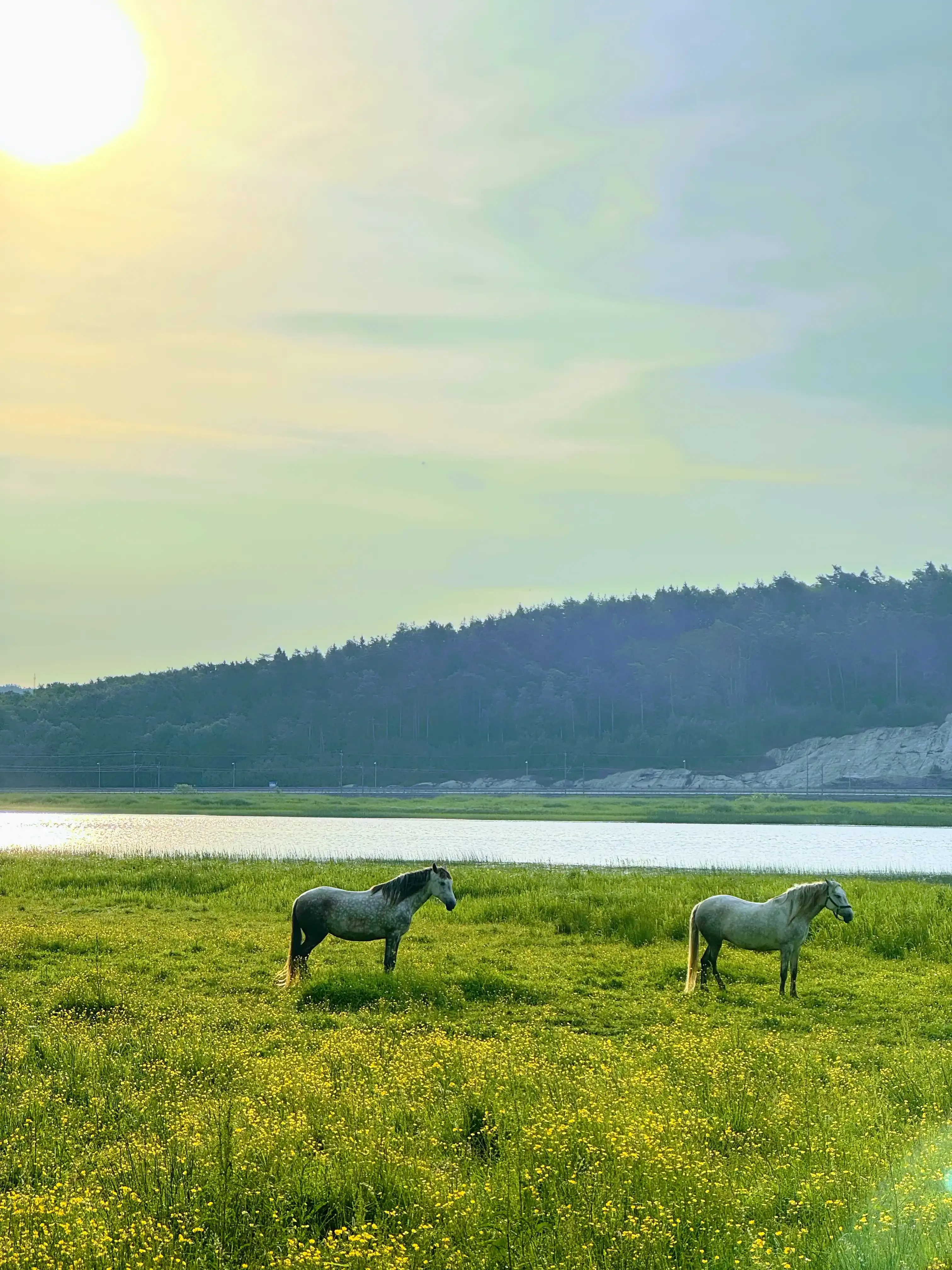 North of Gothenburg, Sweden—white horses that looked straight out of a fairy tale.
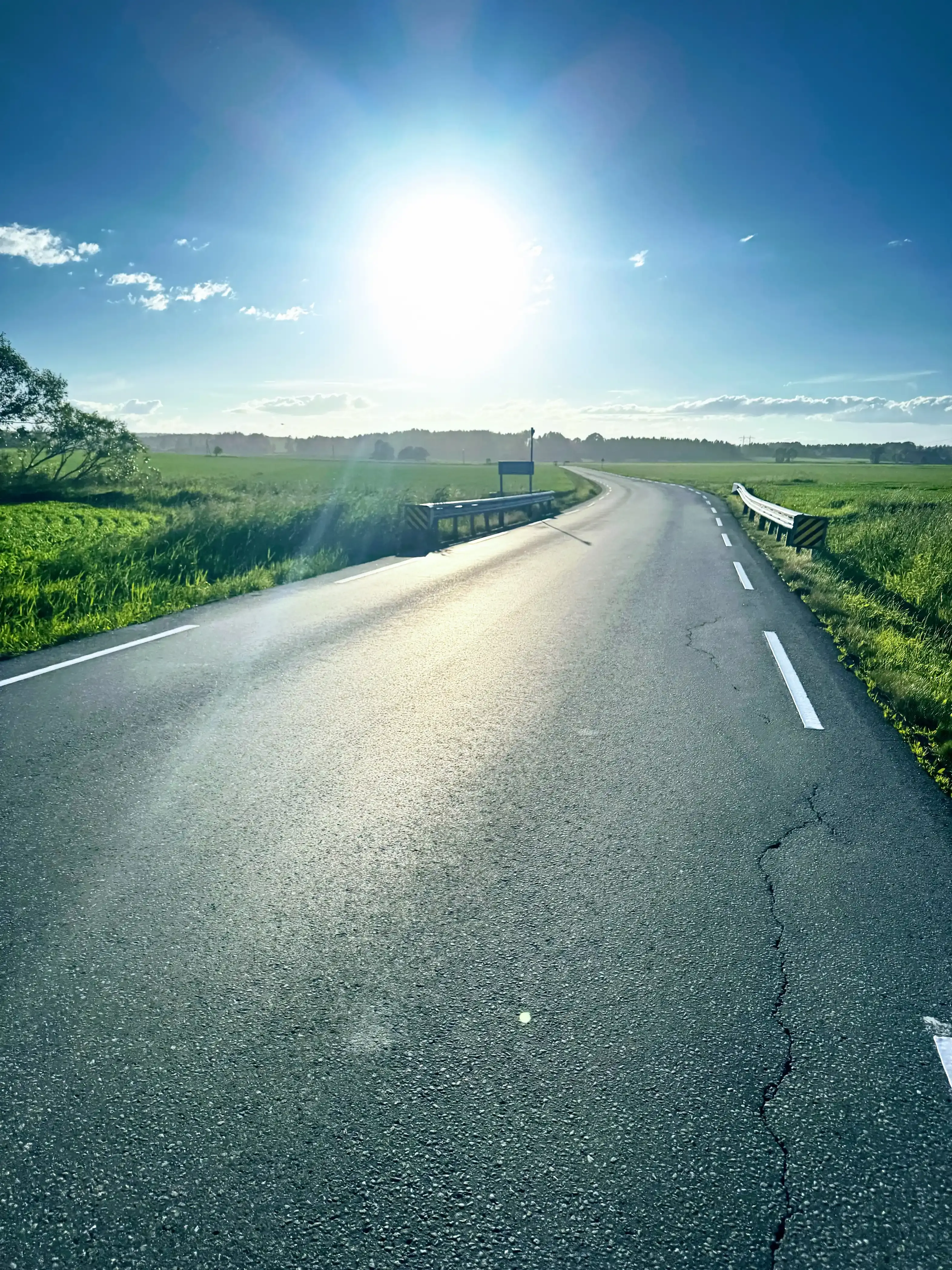 Near Råde, Norway—scenes like this repeated endlessly.
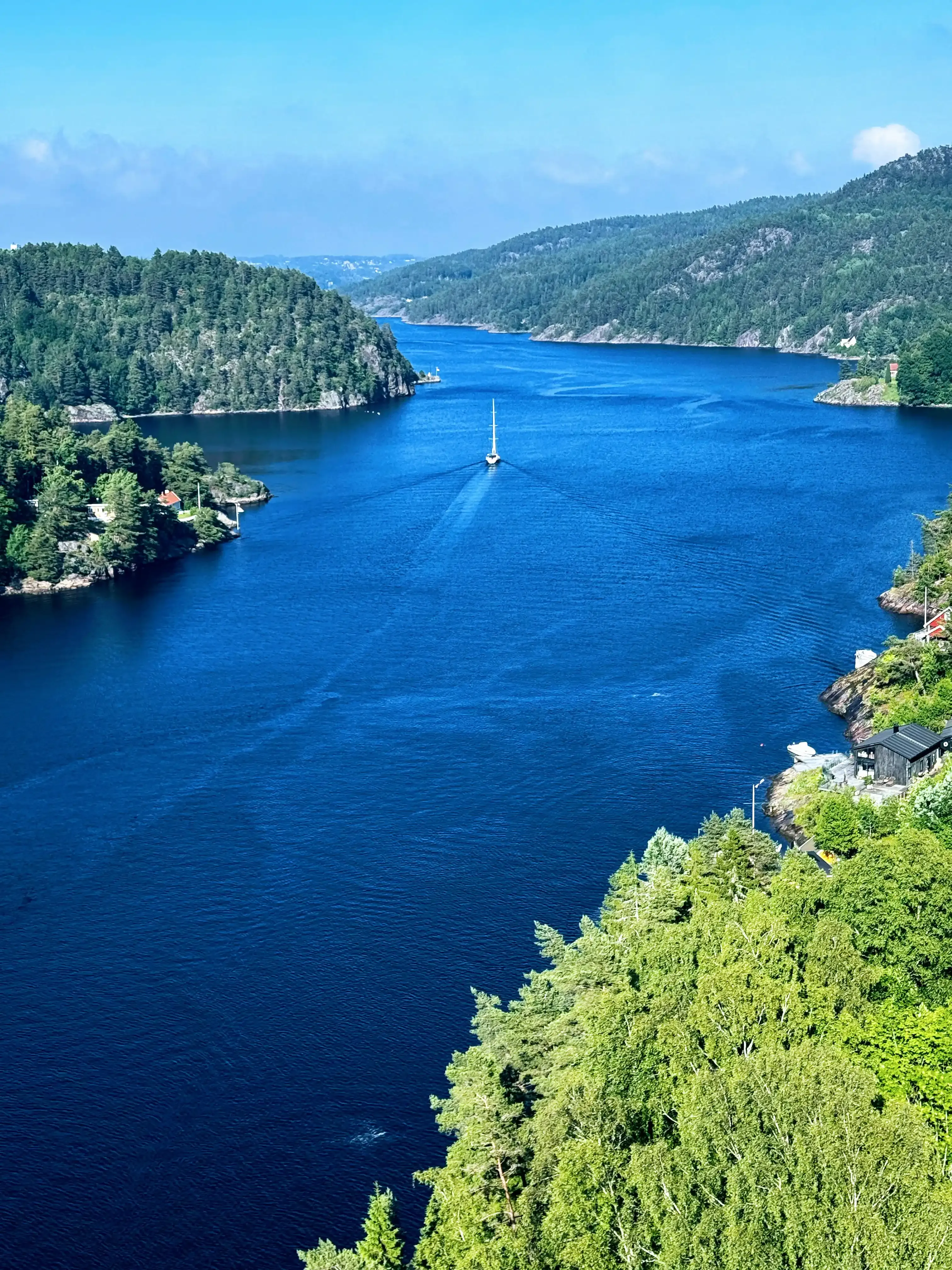 Crossing the Old Svinesund Bridge between Sweden and Norway.
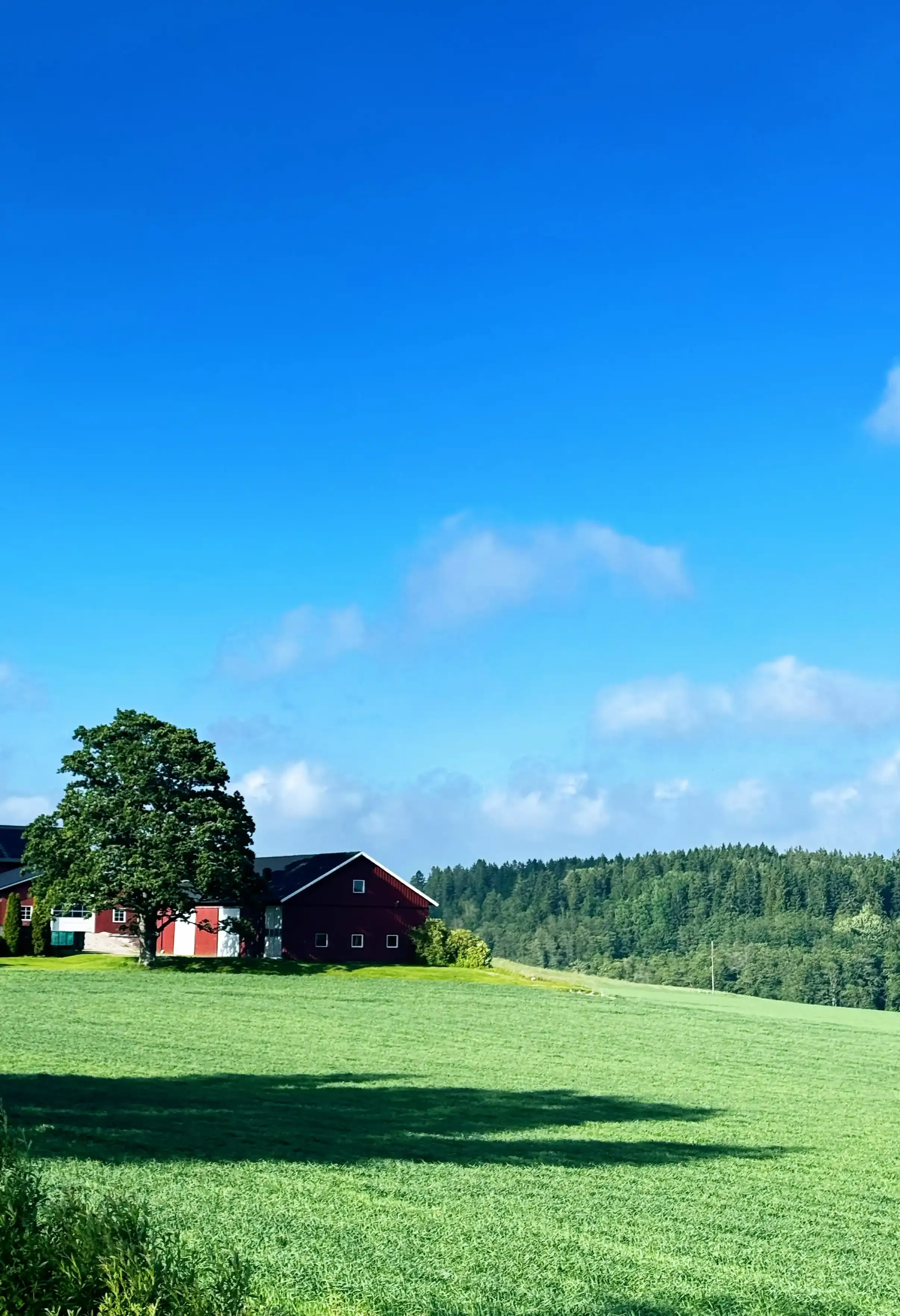 Near Skjeberg, Norway—such a joy to take in these pastoral landscapes from the saddle.
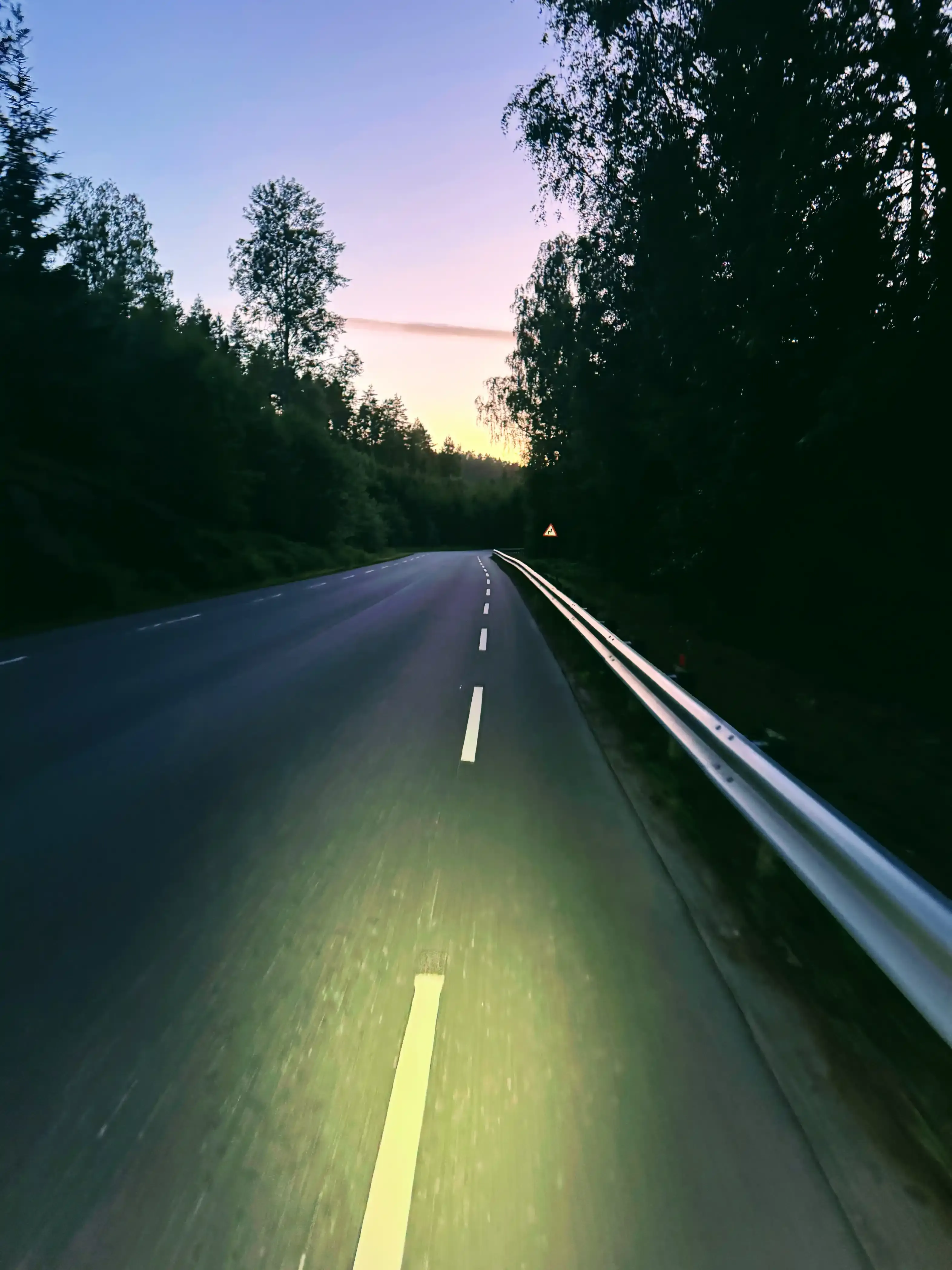 Finally, 15 km to Oslo. Believe it or not, this was midnight.
Sceneries beyond words kept passing me by. Usually, on long-distance rides, the scenery loses its charm after the first few hours, but this time I relied heavily on the landscape to keep going in the latter half. If I had to nitpick a flaw in this route, it would be that the landscape was almost too consistently similar, making it hard to tell if I was making progress.
Why Did I Push So Hard?
Swept up in the excitement from the start, I lost my head and latched onto a fast paceline of stronger riders. Thanks to that, I set personal records (PRs) for 50 km, 100 km, 100 miles, and 180 km during an ultra-distance event! This isn’t a boast—around 250 km, I got dropped from the group, bonked hard, and ended up riding completely solo for the rest of the journey. In my previous 300K BRM, I deliberately rode a gear lighter and stayed away from fast groups, but this time I made an impulsive mistake.
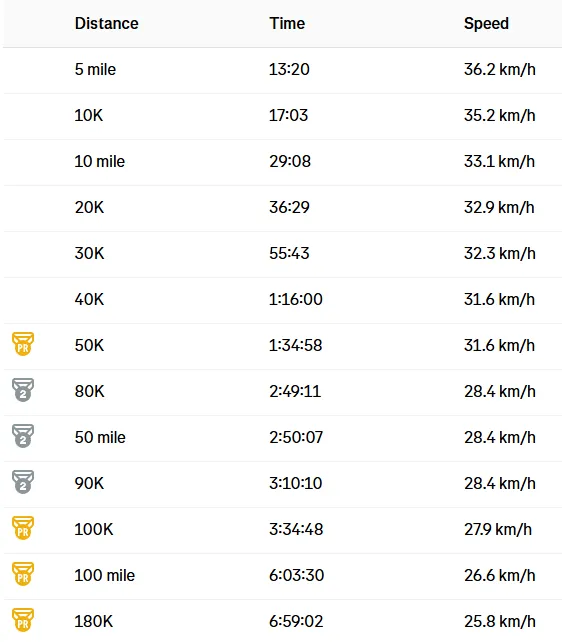 Not a flex, but a record of a tactical mistake.
I finished the 730 km course in 41 hours and 53 minutes total (average speed 17.4 km/h), placing 29th out of roughly 100 participants.
I Could Sleep a Bit Less Next Time
On Day 1, I rode 343 km in 13 hours and 37 minutes, and on Day 2, 388 km in 19 hours and 20 minutes. Doing the math, I spent nearly 8 hours at the hotel, though I only slept for a little over 6 hours. Buying a chicken wrap from a vending machine late at night, washing my kit, and dawdling took up more time than expected.
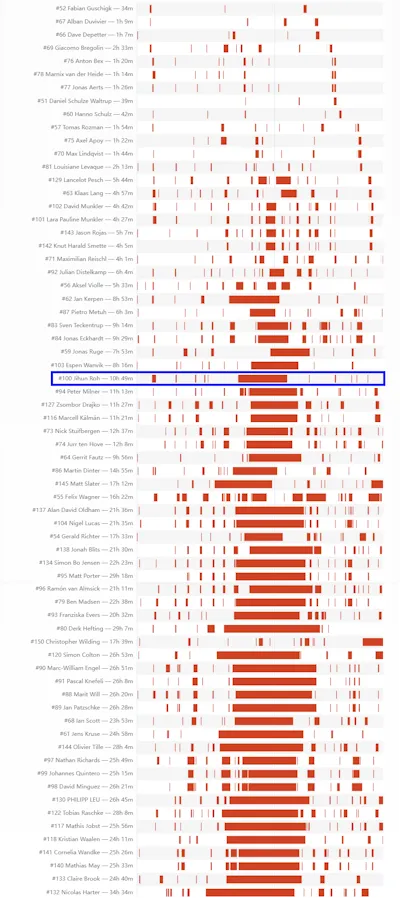 Excerpt from the Stopped Time Chart. I went to bed earlier and slept longer than most top-tier riders.
About 20 riders in the top tier completed the race non-stop without booking hotels. The winner had a total rest time of just 34 minutes! 😱 On the other hand, a rider who rode about 150 km a day over 4 nights was the one I envied the most. After finishing, I kept tracking their live location and rooting for them. Looking up their name on Strava, they had truly soaked in the journey—fields, forests, ocean views, and local food. 👍
If I had pushed the Day 1 stop a bit further and slept only 4 hours, the overall ride might have felt more manageable. Waking up on Day 2 after riding 340 km to Gothenburg and realizing I still had 390 km ahead of me felt terrible—and that kind of mental drag ruins a ride.
Thoughts That Kept Me Going
I once read advice from an experienced randonneur guru stating that simply “loving to ride a bike” isn’t enough motivation for long rides—you need a much stronger answer.
Everyone tells you to prepare mentally for the night, but nobody gives you a real strategy. Negative thoughts will come no matter what. You can’t just ignore them. You need your own ‘answer,’ and that is what mental preparation really is. You will inevitably ask yourself, ‘What on earth am I doing on a bike at this hour?’ What matters is your answer to that question. Prepare a clear answer for ‘why.’ And that answer must be rock solid. I don’t think ‘because I love cycling’ is a good enough answer. At 2 AM, in pitch-black darkness, feeling isolated and cold, you’ll find it very hard to convince yourself that you ‘really love cycling.’
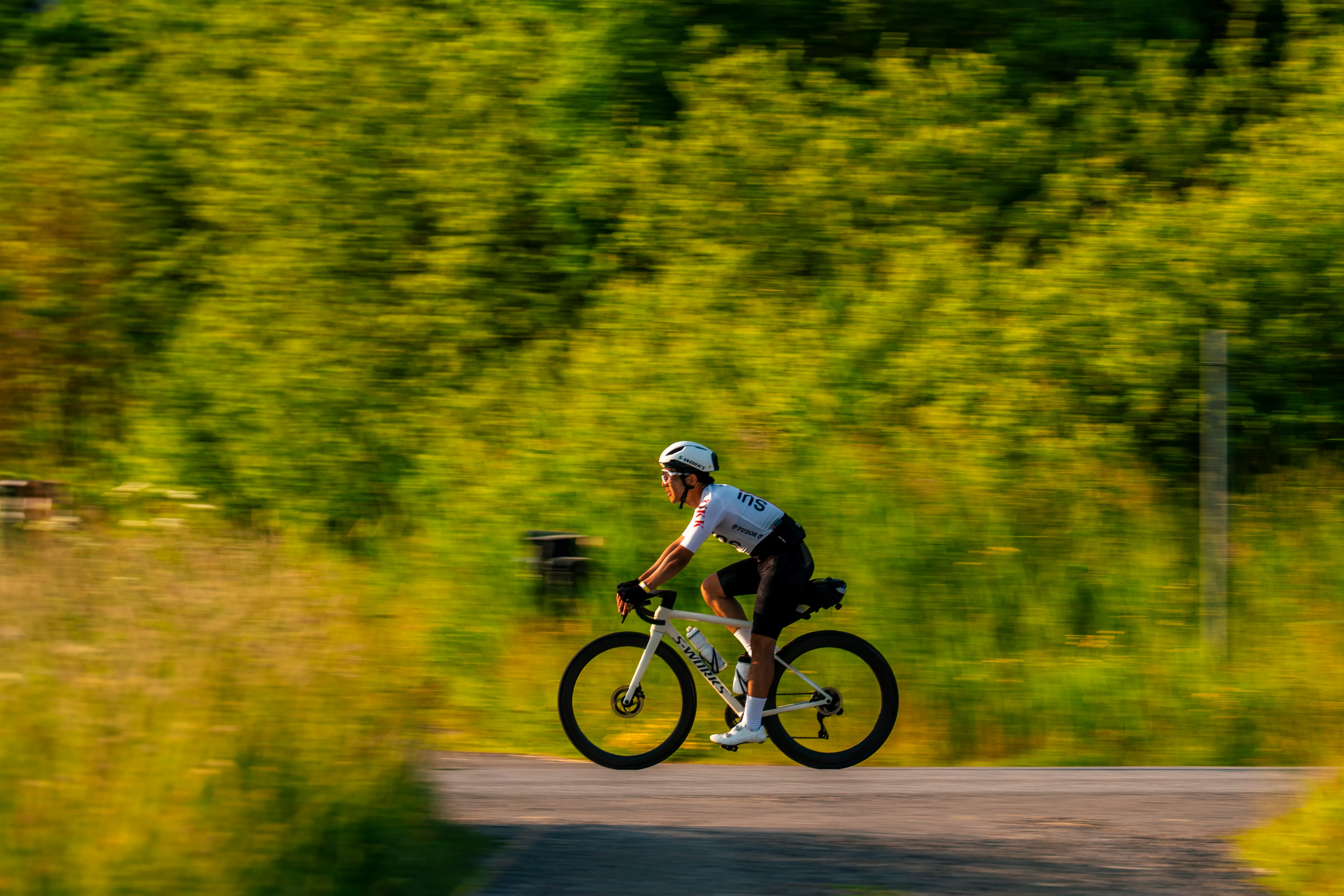 A brilliant panning shot. That’s me.
It sounds a bit silly, but on Day 2 during the 390 km stretch, when I wanted to throw my bike away and briefly considered quitting, I kept myself going by thinking: “Once I finish this, my abs will show!” (I’ll save my long quest for abs for another time…)
Thinking of my loved ones was also immensely helpful. Friends tracking my live location online and sending encouraging messages saying “Not much left, keep going!” gave me a boost. Constantly reminding myself that my loved ones were waiting at the finish line and reading friends’ messages during short breaks gave me the strength to climb back into the saddle.
I also learned that my body craves savory sausage rolls on these long rides. When eating only sweet things like energy gels or bread, my body had physical energy, but my mind stayed foggy. Eating a warm, well-seasoned, greasy sausage roll instantly lifted my spirits. I plan to rely on sausage rolls a lot more in the future.